Strictly Necessary
Required for login, session management, account security, device limits, referral functionality and remembering your cookie choice.

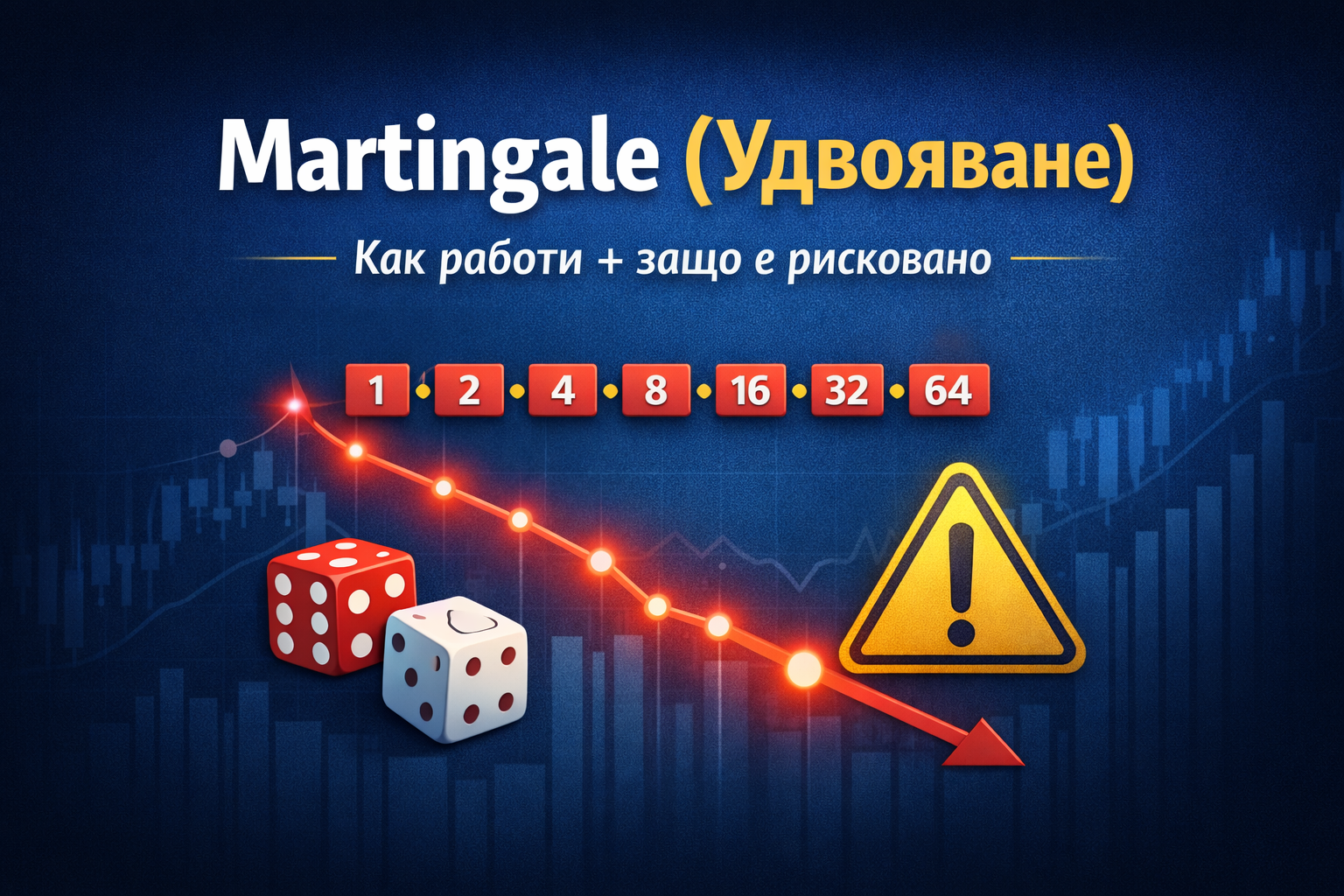
The Martingale strategy, often called the doubling strategy, is one of the best-known betting systems. Its basic idea is simple: after every losing bet, you double your next stake.
It may appear that one eventual win will recover the previous losses and leave a small profit. But that outcome depends on important assumptions — especially decimal odds of exactly 2.00, sufficient funds, and the ability to place every required bet.
Martingale is a high-risk betting system. Stakes grow exponentially, and a losing streak can exhaust your bankroll or hit a bookmaker's betting limits. No staking system can turn an unprofitable bet into a profitable one by itself.
In its simplest form, Martingale follows three steps:
At decimal odds of 2.00, a win at any stage covers all earlier losses in that sequence and produces a net profit equal to the initial stake — provided you can afford and place the winning bet. This is not a guarantee that a win will arrive before your limit is reached.
Imagine starting with a €1 stake. The following is a hypothetical sequence at decimal odds of 2.00:
| Bet | Stake | Result | Total Staked So Far |
|---|---|---|---|
| 1 | €1 | ❌ Loss | €1 |
| 2 | €2 | ❌ Loss | €3 |
| 3 | €4 | ❌ Loss | €7 |
| 4 | €8 | ✅ Win | €15 |
The calculation:
At odds below 2.00, simply doubling does not necessarily recover all previous losses. Real markets also involve changing prices, suspended markets, and stake limits.
The system feels convincing because many short sequences end with a win and a small profit. The problem is the assumption that you can keep doubling indefinitely.
In reality:
One large losing sequence can wipe out the small gains from many successful sequences. Martingale changes the size and distribution of wins and losses; it does not improve the underlying probability of an outcome.
1 → 2 → 4 → 8 → 16 → 32 → 64 → 128 → 256...
The ninth stake is already €256, and placing all nine stakes would require €511 in total — just to target a €1 net gain if the ninth bet wins at 2.00.
A fixed limit does not make Martingale safe or profitable. It only prevents an unlimited escalation of stakes.
Decide the maximum number of bets, maximum total amount at risk, and when to stop. Never increase these limits after a loss.
For a broader explanation of setting limits, read our Bankroll Management guide.
Some bettors look for high-probability outcomes, such as Over 0.5 Goals, or matches with strong attacking statistics. These factors may help assess a football market, but they do not make Martingale mathematically reliable.
When assessing a market, consider:
If you cannot afford to lose the entire planned sequence, the appropriate choice is not to begin it.
Rather than increasing stakes after losses, consider flat betting with a small, predefined amount you can afford to lose. A fixed stake limits the size of an individual loss, although it does not remove betting risk or guarantee profit.
It can also help to track results over a meaningful sample, separate your assessment of the match from your decision about stake size, and take a break rather than trying to win losses back immediately.
No. Finite bankrolls, stake limits, losing streaks, and changing odds mean a sequence can end with a large loss.
No. The familiar “one win recovers everything plus one unit” example assumes decimal odds of 2.00 and that every required stake can be placed.
No. Live statistics may provide context for a match, but they do not eliminate uncertainty or the exponential growth of stakes.
This article is educational and does not provide a guaranteed betting system. Gambling involves financial risk. Never chase losses or wager money you cannot afford to lose. Read our Responsible Gambling information.
Conclusion: Martingale is easy to understand but extremely demanding on your bankroll. Its appeal comes from frequent small recoveries; its danger comes from rare, potentially devastating losing sequences. Discipline and limits matter, but they do not make the strategy profitable.